
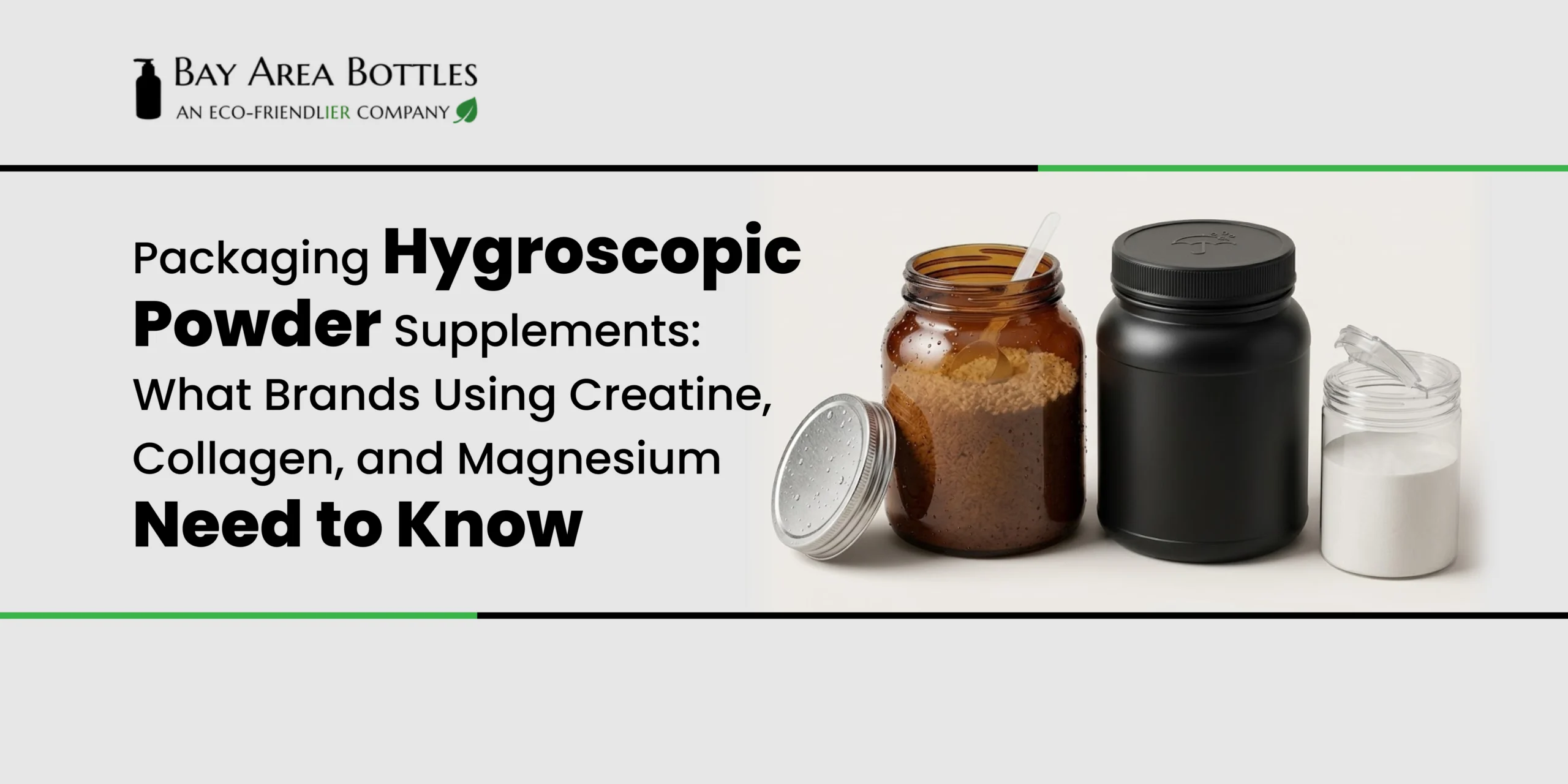
Powder supplements have a packaging problem that most brand owners discover too late. The ingredients that are most popular right now are also the most sensitive to moisture. Creatine monohydrate, collagen peptides, and magnesium forms are three of the fastest-growing supplement categories, and all three are hygroscopic. This means they actively pull moisture from the air. Put them in the wrong packaging, and they clump, cake, degrade, and in some cases lose measurable potency before the customer finishes the container.
Worry not, this is a solvable problem. But solving it requires understanding exactly what hygroscopic means at the material level. You must understand what the packaging science says about container performance and how to match your specific powder supplement to the bottle, closure, and secondary protection it actually needs.
Hygroscopic compounds do not just absorb surface moisture. They draw water vapor even out of the surrounding air through a process of adsorption and absorption, and the rate at which they do this accelerates as ambient relative humidity rises. At high relative humidity (above 60%), unprotected hygroscopic powders can absorb enough moisture to trigger physical and chemical changes within days. And no one wants that, right? The consequences can be devastating:
Water molecules bind powder particles together. It forms aggregates that resist scooping, measure inconsistently, and create negative consumer experiences that drive returns and one-star reviews.
Moisture accelerates hydrolysis and oxidative degradation in sensitive actives. Research published in ResearchGate documented that collagen hydrolysates exhibit high hygroscopicity, with moisture absorption leading to bioactivity reduction during storage.
Water activity above 0.60 supports microbial growth. A 2026 PMC-published study on hygroscopic medication packaging confirmed that moisture absorption in hygroscopic compounds directly reduces therapeutic efficacy and creates deterioration of physical properties. Packaging that allows moisture ingress can push water activity above that threshold during storage.
Powders that have absorbed moisture lose the free-flowing properties that make them easy to scoop and mix. This is a common usability issue for protein powders and greens blends. It can also signal a chemical change in the monohydrate structure of creatine.
Creatine monohydrate is moderately hygroscopic. When it absorbs moisture, the monohydrate crystal structure can convert to creatinine, a degradation product with no ergogenic value. The conversion rate accelerates with both moisture and heat. This makes moisture barrier performance the primary packaging requirement for creatine.
HDPE powder supplement bottles with induction-sealed liners are the validated standard for creatine packaging. HDPE’s moisture vapor transmission rate (MVTR) of 0.5 significantly outperforms PET’s MVTR of 2.0 for moisture protection. Adding a desiccant packet inside the container adds a secondary moisture control layer, which is important for formats sold in humid climates or with extended shelf life claims.
The high hygroscopicity of collagen peptides is a direct consequence of their molecular structure. Collagen hydrolysates are rich in hydrophilic amino acid sequences that readily bind water. This makes collagen one of the most demanding powder supplements to package correctly.
HDPE wide-mouth bottles with induction seals are the appropriate format. Headspace management matters more than with most other powders for collagen. Because collagen settles significantly after filling.
Brands that overfill to minimize the appearance of a partially empty container often create a headspace problem that leaves insufficient air volume for desiccant activity. The correct approach is a fill weight appropriate to the container volume, with 20 to 30% headspace, plus a silica gel desiccant packet sized for the container volume and the expected shelf life under storage conditions.
Magnesium citrate and magnesium oxide are moderately hygroscopic. However, magnesium chloride and magnesium glycinate are significantly more hygroscopic. Magnesium chloride in particular is highly deliquescent at relative humidity above approximately 33%, meaning it can absorb enough moisture to dissolve partially into its own absorbed water.
For any magnesium powder format, HDPE bottles with induction seals and desiccant packets are the appropriate packaging system. Container sizing should account for the tendency of magnesium powders to absorb moisture and increase in weight during the shelf life if the closure system is breached or if the container is opened frequently.
The pharmaceutical industry established HDPE as the standard container for hygroscopic solid dosage forms decades ago, and the dietary supplement industry has adopted those same standards. HDPE Plastic bottles are the most ideal for modern supplement packaging for several reasons.
Under USP Chapter 671, containers are classified based on moisture permeability. A “well-closed” container must not exceed 2,000 mg of moisture permeability per day per liter. HDPE consistently meets this standard. PET, depending on bottle size and wall thickness, is more variable and carries an MVTR four times higher than HDPE.
The dietary supplement industry has adopted the same regulations used in pharmaceutical packaging. Containers and closures used to package dietary supplements typically include HDPE, PET, unit dose blisters, pouches, and blister cards. Because the ingredients intended for these packages can be sensitive to moisture, light, oxygen, and heat, it is vital that the packaging prevents disintegration of the product.
Under FDA 21 CFR Part 111, dietary supplement manufacturers must establish specifications for packaging components and verify that packaging does not interact with supplement ingredients in ways that affect identity, purity, quality, strength, or composition.
HDPE satisfies both the USP performance standard and the FDA cGMP compatibility requirement for hygroscopic powder supplements. PET does not reliably meet USP moisture standards for the most hygroscopic formulas. Glass exceeds HDPE on moisture barrier performance but costs more. It’s also heavier for shipping and is typically unnecessary for powder formats where HDPE with an induction seal performs within the stability requirements for the vast majority of products.
Container size is where many brands make costly errors. Getting this wrong affects fill weight accuracy, desiccant performance, regulatory compliance, and the customer’s experience opening the product.
How to get it right? Let’s find out.
Powder supplements settle during shipping and handling. A container filled to the brim has no room for a desiccant packet and creates a false impression of underfill when the customer opens it. That’s why the industry practice and USP guidance support leaving 20 to 30% headspace above the settled powder, with the remaining space occupied by the desiccant and label-disclaimed fill weight.
The most common powder supplement container sizes for retail are:
A narrow neck opening makes scoop access difficult or impossible for standard supplement scoops, which range from 5ml to 30ml in volume depending on the serving size. The wide mouth also improves aeration during scooping, which reduces static charge buildup that causes powder to cling to container walls.
Square or rectangular HDPE containers provide flat label panels that accept high-resolution printing cleanly and use shelf space more efficiently than round containers of equivalent volume. Also, these rectangular or square-base wide-mouth HDPE container offers practical advantages over round bottles at larger volumes for retail-positioned powder supplements where label real estate matters.
A well-selected HDPE bottle with the wrong closure system provides incomplete protection for hygroscopic powder supplements. The data above shows that the closure system has two required components.
Do not default to the smallest available size of desiccant packet. Instead, match the desiccant gram weight to the container volume and the moisture sensitivity of the active ingredient. The desiccant packet must be placed on top of the powder after filling, not mixed into it. It should sit above the induction seal during shipping, then drop onto the powder surface when the customer removes the seal at first opening.
Before placing a wholesale bottle order for a hygroscopic powder supplement, confirm each of these:
Hygroscopic powder supplements are a packaging problem with a defined, validated solution. HDPE bottles built for powder supplement packaging, correctly sized with appropriate headspace, sealed with induction liners, and loaded with correctly specified desiccant, protect the potency and physical integrity of creatine, collagen, magnesium, and every other hygroscopic active through the full shelf life.
Get those specifications right before production begins. Changing packaging mid-run, after a batch has caked or a product review mentions clumping, costs significantly more than getting it right the first time.