
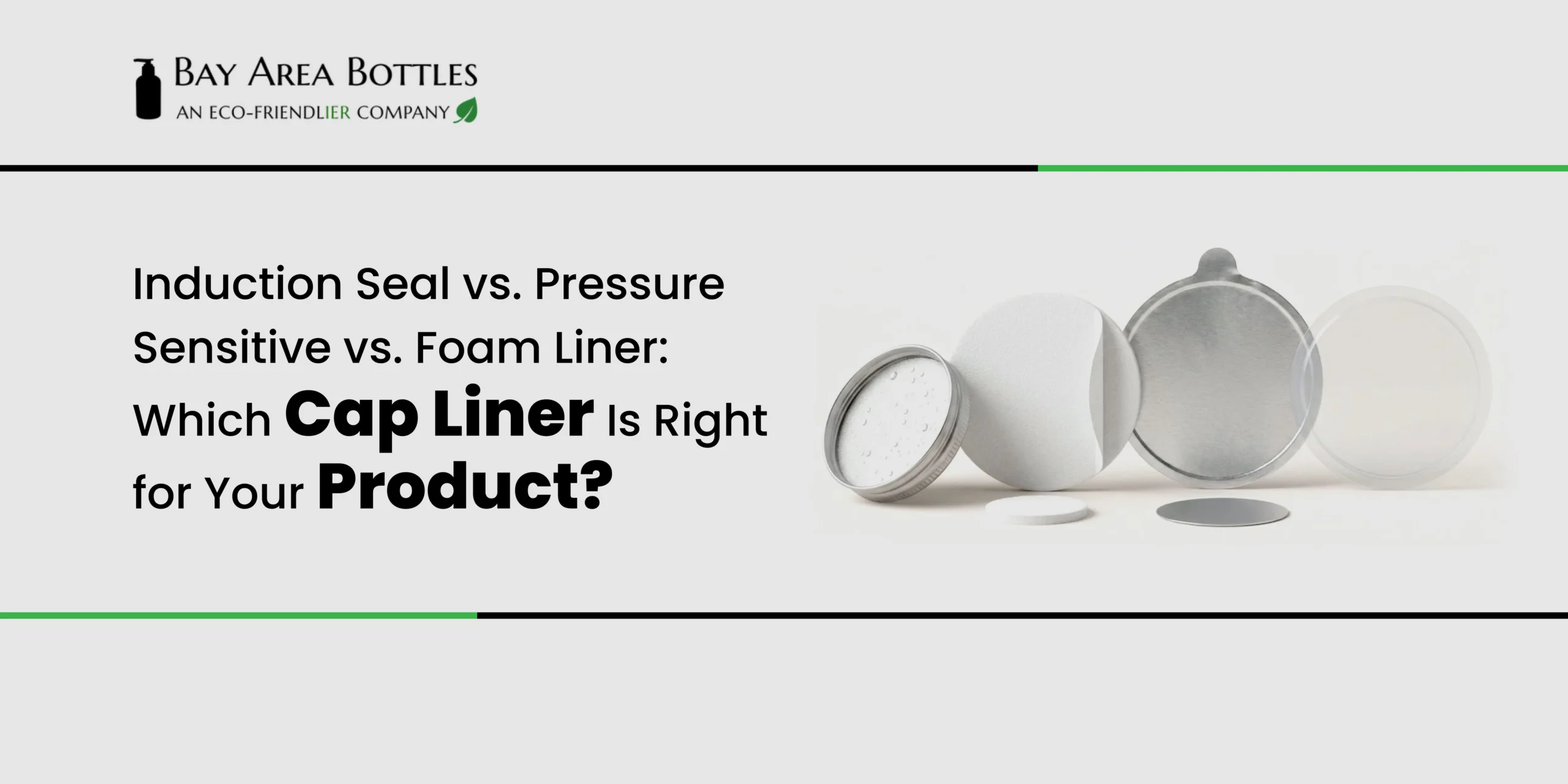
Cap liners do not get much attention in product development conversations. Most brand owners pick one because their bottle supplier includes it by default, or because the co-packer uses it, or because it looks fine on a sample. That approach works until it does not. Until a batch leaks in transit, a retail buyer flags missing tamper evidence, or a hygroscopic powder starts clumping before the expiration date.
Cap liners are not interchangeable. Each type, be it an induction seal, pressure sensitive, or foam liner, has a specific performance profile, a specific set of compatible applications, and specific situations where it fails. Choosing correctly from the beginning is significantly cheaper than reformulating your packaging after a production run.
Here is exactly how each liner type works, where each one belongs, and how to make the right call for your product.
A cap liner is a disc of material fitted inside a bottle cap that creates a seal between the cap and the container’s neck opening. Depending on the liner type, it can form a hermetic seal (airtight and moisture-tight), provide tamper evidence, prevent leakage during distribution, extend shelf life by limiting oxygen ingress, and protect product integrity from the filling line to the consumer.
Considering cap liners just a backup measure is a critical mistake that can cost you later in refunds and product recalls. These simple cap liners are the primary barrier between the product and everything that can degrade it, due to moisture, oxygen, or contamination.
Induction seal liners are also called heat induction liners. They are multi-layer structures typically consisting of a pulp or foam backing bonded to an aluminum foil layer with a heat-seal coating. The cap is applied to the filled bottle as normal. The sealed bottle then passes through an induction sealing machine, which generates an electromagnetic field. That field induces an electric current in the aluminum foil layer, generating heat. The heat activates the bonding coat and fuses the foil directly to the container’s neck.
The backing layer separates and remains inside the cap. The foil is permanently bonded to the bottle. The result is a hermetic seal. It’s airtight, moisture-tight, and physically bonded in a way that cannot be removed and replaced without visible evidence of tampering.
Induction seals provide the strongest barrier performance of any cap liner type. They create a hermetic seal that blocks oxygen, moisture, and contaminants at the container opening. This directly extends shelf life for moisture-sensitive and oxygen-sensitive products. They also provide the clearest tamper evidence available in a liner format. A breached induction seal is immediately visible. The foil tears visibly on first opening and cannot be resealed.
The FDA recognizes induction sealing as one of the most effective methods for tamper evidence in packaging. Two-piece induction liners include a reseating backing that returns to the cap after first opening, providing continued moisture and oxygen protection during use. One-piece liners bond permanently and do not reseat, making them appropriate for single-use or minimal-reuse products.
Induction seals bond to HDPE, PET, PP, and PVC containers. They do not bond reliably to glass without a specialized formulation. The caps arrive with the liner installed; the bonding only occurs during the sealing pass. A bottle capped with an induction liner that was never run through a sealer has no meaningful seal.
However, heat induction seals are not suitable for products containing oil. The foil-to-container bond is compromised by oil contact at the sealing surface. For oil-based supplements, topical oils, and essential oils, a different liner type is required.
Pressure sensitive liners consist of a foam base layer with an adhesive coating on the container-facing side and a release coating on the cap-facing side. When the cap is applied and tightened, the pressure activates the adhesive, bonding the liner to the container’s neck opening. When the cap is removed, the liner detaches from the cap and stays bonded to the bottle, where it remains until the consumer peels it off.
No heat, no equipment, no sealing machine required. The liner bonds through hand-tightening the cap.
Pressure sensitive liners provide tamper evidence because the liner remains on the bottle after the first opening. They offer moderate barrier performance against dust, contamination, and limited oxygen exposure. They do not form a hermetic seal, though. Pressure sensitive liners cannot reliably block moisture ingress over extended storage periods and are not appropriate for liquid products due to leak risk.
Unlike an induction liner, which creates an airtight hermetic seal, pressure sensitive liners are unable to protect product integrity from spoilage due to oxygen and moisture transmission.
The PS22 liner is the most common pressure sensitive formulation in the supplement industry. It is compatible with glass, metal, and plastic containers.
However, due to market constraints, the polystyrene foam market has been shrinking. This has resulted in decreased availability of pressure sensitive liners. Brands relying on PS22 liners should verify current supply availability and lead times with their packaging supplier before making any packaging decision.
Pressure sensitive liners are not appropriate for liquids, for products requiring a hermetic moisture or oxygen barrier, or for any product distributed in high-humidity environments where moisture ingress is a shelf-life risk.
Foam liners are the simplest liner type. They are a disc of compressible foam, typically polyethylene (PE) or the F217 three-layer construction (a foam core between two layers of LDPE film), fitted inside the cap. When the cap is tightened, the foam compresses against the container neck and creates a physical seal through compression.
There is no adhesive and no bonding. The liner stays inside the cap on every opening and closing. It is a reusable, resealable barrier that remains functional through the container’s full use life.
Foam liners provide a basic compression seal that prevents leakage from liquids and solids under normal storage and shipping conditions. F217 foam liners have low moisture transmission rates and good taste and odor resistance, making them appropriate for food-grade applications.
Foam liners do not provide tamper evidence. A foam liner can be removed and replaced without any visible indication of access. They are not appropriate for any product or channel where tamper evidence is a regulatory requirement or a consumer expectation.
They are the correct choice for products that are opened and resealed frequently by the consumer, where the liner needs to maintain seal integrity across dozens of open-close cycles.
Foam liners are not appropriate for products requiring tamper evidence, for OTC pharmaceutical products subject to 21 CFR 211.132, or for any product where the hermetic barrier performance of an induction seal is required by stability data or regulatory standard.
| Property | Induction Seal | Pressure Sensitive | Foam |
| Hermetic seal | Yes | No | No |
| Tamper evidence | Yes, visible foil tear | Yes, liner stays on the bottle | No |
| Equipment required | Yes, induction sealer | No | No |
| Reusable after opening | Two-piece only | No | Yes |
| Liquid compatibility | Yes (not oil-based) | No | Yes |
| OTC pharmaceutical compliance | Yes (21 CFR 211.132) | Situational | No |
| Moisture barrier | High | Moderate | Low-moderate |
| Cost per unit | Higher | Moderate | Low |
If your product is an OTC drug or supplement distributed through retail channels, tamper evidence is a baseline expectation, and for OTC pharmaceuticals, it is a federal regulatory requirement. Induction seals satisfy this cleanly.
If the product is a liquid, an induction seal or foam liner are the appropriate options. Pressure sensitive liners are not rated for liquid contact. If the product is oil-based, an induction seal is not appropriate regardless of the container material. If the product is a hygroscopic powder or a moisture-sensitive solid, the hermetic barrier of an induction seal will outperform a pressure sensitive liner over the full shelf life, particularly in distribution environments with variable humidity.
Induction seals require a sealing machine. If that equipment is not on your filling line or at your co-packer, pressure sensitive liners are the practical alternative for products where hermetic sealing is not required. Foam liners require no equipment and no adhesive activation.
If you are sourcing cap lining services rather than applying liners in-house, confirm that the service provider’s sealing equipment is calibrated for your specific container material, cap type, and liner specification. Induction sealing power and dwell time must be set correctly for the container wall thickness and resin type, or the seal will be incomplete.
The right cap liner for your product is determined by what the formula requires, what the regulatory environment demands, and what your filling operation can execute. Match those three factors, and the decision makes itself. The above decision maker will help you determine the best solution for your product.