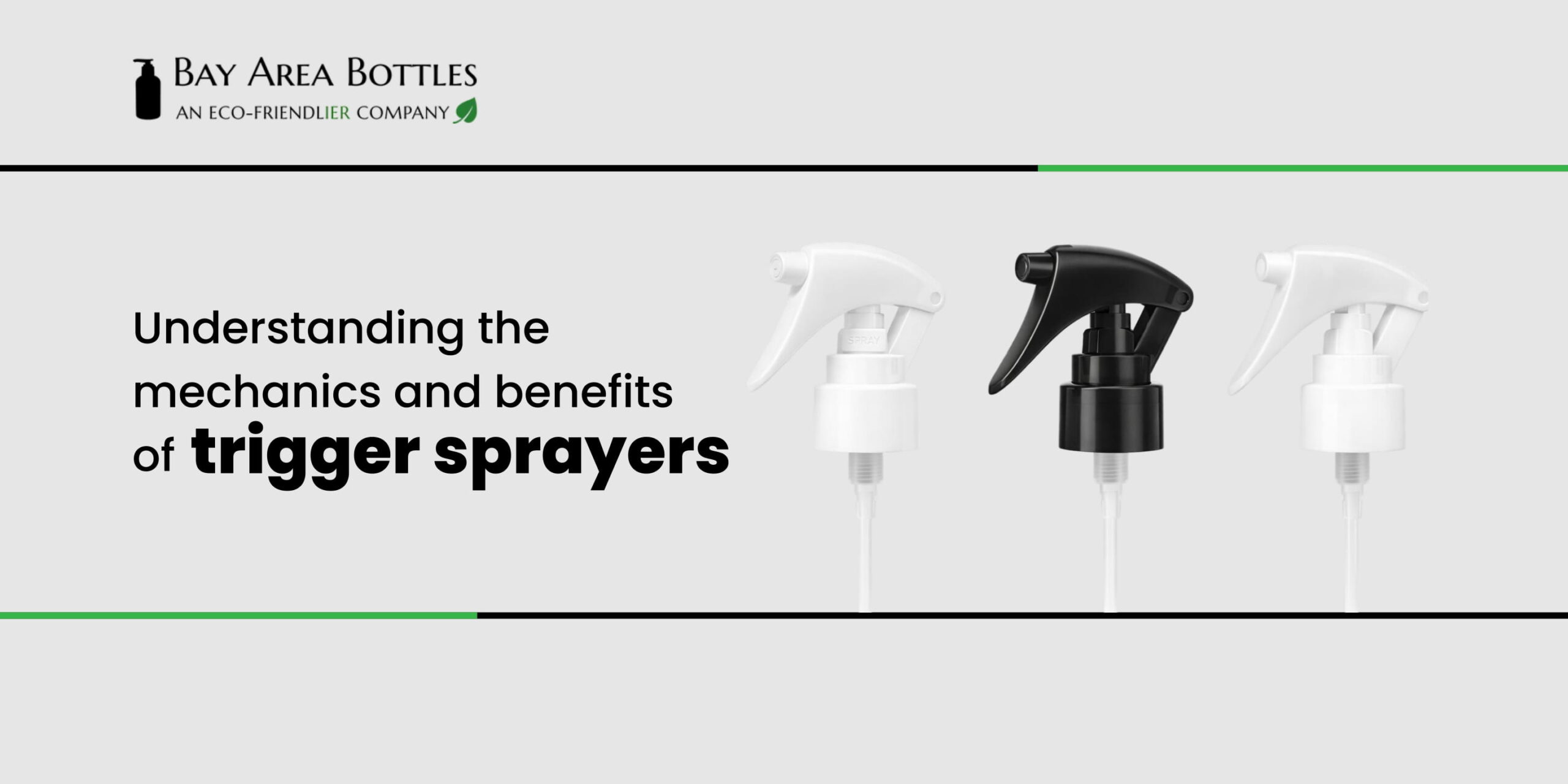
As the name suggests, trigger sprayers are trigger-activated. These sprays are designed for precise dispensing. The defining features of a trigger sprayer are the dip tube and adjustable nozzle. This flexibility makes them versatile and indispensable in many industries. You can easily find one around you.
Glass cleaner, disinfectant, hair detangler, plant mist, kitchen degreaser, etc., all use trigger sprayers for precision. But you squeeze the trigger spray without ever thinking about how it works and where it can be more beneficial. You just use it, and a fine mist or steady stream sprays out. Simple, right? Actually, not. The trigger mechanism has a lot more to unfold.
But for a brand owner or a product manufacturer, understanding the mechanics and benefits of trigger sprayers is strategic. The type of trigger sprayer used will impact the effectiveness of the product, the safety of the user, the precision of the dosage, the customer satisfaction, and the ability to meet regulations. So, let’s break it down in a relaxed and informal way, as if we are having a cup of coffee and talking about packaging.
Knowing the components of a trigger sprayer bottle will help you make a wiser choice in picking the right packaging. Here are the components:
Despite design variations, the internal principle remains consistent across most trigger sprayers on the market.
A trigger sprayer is based on a basic principle of pumping and vacuum action. It converts your hand movements to hydraulic pressure to force the liquid out of the nozzle. This is how it actually works.
When you pull the trigger of the sprayer, the piston moves down and presses the spring inside the closed chamber. This action forces the liquid out of the nozzle. Now, when you release the trigger of the sprayer, the spring moves the piston upwards. This action creates a vacuum, which pulls the liquid upwards through the dip tube. The mechanism resets and is ready for the next action.
One of the biggest advantages of trigger sprayers is adjustable output.
Most models offer:
The nozzle design determines how the liquid breaks into droplets. This directly affects surface coverage, chemical effectiveness, and user control.
Let’s talk about why brands continue to rely on this dispensing system.
Trigger sprayers allow users to apply the product exactly where needed. This reduces waste and improves efficiency. For example, disinfectants must remain on surfaces for a specified dwell time to be effective. According to the Centers for Disease Control and Prevention (CDC), proper application and surface coverage are critical for disinfectant effectiveness. A well-designed trigger sprayer ensures even distribution and adequate coverage.
In terms of safety in the use of chemicals and cleaners, it is important to ensure that the skin does not come into direct contact with the chemicals or cleaners in question. The use of a trigger sprayer ensures that there is no direct skin contact with the chemicals or cleaners in question. The reason why this is important is that the U.S. Consumer Product Safety Commission (CPSC) reports thousands of cases of exposure to chemicals from cleaners every year.
Trigger sprayers have a wide scope of use in terms of the different kinds of products they can be used with. They can be used with cleaners, sprays used in the detailing of cars, fertilizers used in the garden, pet sprays, hair sprays, and degreasers, among many other uses. The versatility of the sprayer is one of the most interesting features of this product.
High-quality trigger sprayers are built for repeated use. Many are designed for hundreds of spray cycles. Durability matters especially in industrial or commercial settings where repeated dispensing is required daily.
From a business point of view, trigger sprayers are a sweet spot for performance and cost. They are available in standard neck finishes and require little customization. It is also easy to purchase wholesale trigger sprayer bottles in bulk.
Trigger sprayers are made of different materials. Typically, each component is either made of plastic or metal. The body and housing are usually made from Polypropylene (PP), the dip tubes use Polyethylene (PE), while the springs are usually made from stainless steel in standard trigger sprayers.
However, some chemical-resistant models use all-plastic springs to prevent corrosion. Meanwhile, specialty seals are also added to store aggressive formulas and prevent their leakage. If you’re packaging acidic or solvent-based products, always verify material compatibility.
Most brands often make one mistake. They assume one sprayer fits all formulas. But that’s not the case. Each product has different demands, which require different sprayers. So if you are considering a trigger sprayer for your product, ask yourself the following questions before making your decision.
Trigger sprayers work best with low to medium-viscosity liquids. Thick products may clog or strain the mechanism.
Choose chemical-resistant models for acids, bleach, or solvents.
Cleaning products benefit from broader spray patterns. Hair or plant mists require fine atomization.
Common sizes include 28/400 and 28/410. Compatibility is essential.
Some trigger sprayers include safety mechanisms for regulated products.
Sustainability is non-negotiable now. Governments are getting stricter, consumers are more aware, and the environmental impact is clear. According to the EPA, improving packaging design plays a role in reducing environmental impact. Companies are ditching multi-material designs. Mono-material designs are easier to recycle compared to mixed-material components.
That’s why some manufacturers now offer recyclable trigger sprayers. They are using reduced-plastic designs and replaceable sprayer systems. Moreover, the plastic components are made using post-consumer resin (PCR).
If you are a brand aiming to align with sustainability goals, you should prioritize mono-material sprayers, refill bottle systems, and long-lasting, reusable sprayer heads.
Solution: Ensure the dip tube reaches the bottom of the bottle, and the product viscosity is suitable.
Solution: Use nozzle-off position and proper torque when sealing.
Solution: Use chemical-resistant, all-plastic spring models.
Solution: Test nozzle quality and ensure no clogging particles in the formula.
Pre-launch testing is essential. Always conduct compatibility and cycle testing before scaling production.
Trigger sprayers may look simple, but they’re carefully engineered systems designed for precision, safety, and efficiency. The mechanism uses a pressure and vacuum cycle with controlled nozzle atomization and one-way valve systems.
These sprays benefit brands in many ways. Sustainable trigger sprays reduce waste, while the trigger mechanism improves safety. The functionality helps boost customer satisfaction and enhance product performance.
If you’re selecting packaging for cleaners, garden products, automotive sprays, or low-viscosity liquids, a well-designed trigger sprayer is often the smartest choice. Packaging is more about safety, performance, and brand trust. Tigger sprayers check all the boxes. And when you understand the mechanics behind it, you make better decisions.