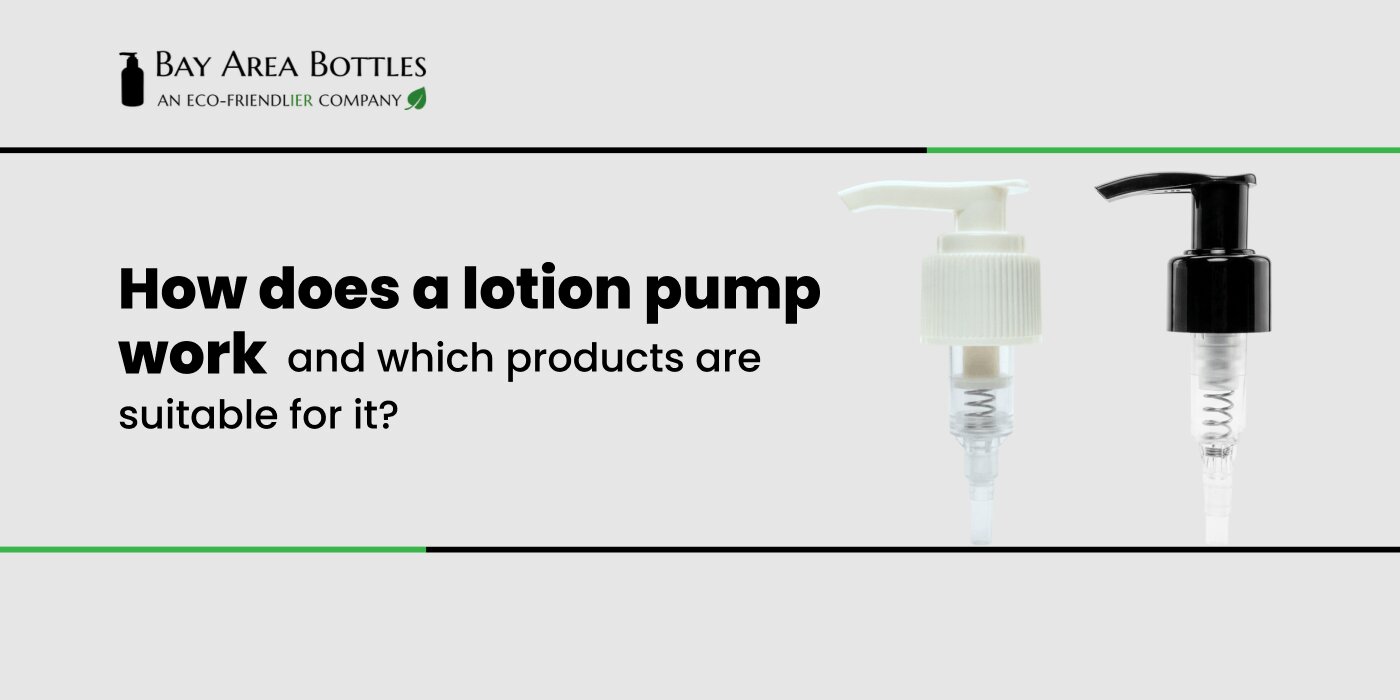
Let me ask you something: how many times a day do you press down on a lotion pump without even thinking about it? Hand soap. Body lotion. Shampoo. Conditioner. Sanitizer. Maybe even a facial cleanser and whatnot. We all have at least one lotion pump in our vanity and hygiene products.
Lotion pumps are one of the most widely used dispensing systems in personal care and cosmetic packaging. They’re simple, convenient, and incredibly efficient. But have you ever stopped to wonder how a lotion pump works? This pump ensures you get the right amount of product time after time. The market is saturated with different lotion pump designs. But the basic principle remains the same.
Understanding the mechanism behind a lotion pump is actually quite interesting. But if your brand has any thick, viscous liquid products, this understanding becomes essential. Choosing the right pump directly affects product performance, dosing accuracy, user experience, and even customer satisfaction.
That’s why Bay Area Bottles has taken apart lotion pumps piece by piece to help you understand exactly how they function. We will give you a complete overview of each component and how they contribute to getting the product out of the bottle in your hand. Moreover, we will also share which products truly benefit from them.
So let’s break it down in a way that’s easy to understand.
Before we get technical, let’s talk about why lotion pumps are so popular.
The U.S. Environmental Protection Agency (EPA) reports that containers and packaging represent a significant portion of municipal solid waste. This amounted to approximately 82 million tons in 2018 and is increasing every year. Due to this, packaging efficiency and functionality are critical design considerations for brands.
Today, consumers are aware of the environmental impact of this packaging waste. So they expect something that offers sustainability. They need packaging that keeps the product secure and stable for a long time. That means no contamination, no product waste, and no complicated dispensing mechanisms. Consumers expect:
A lotion pump checks all those boxes.
Meanwhile, the business perspective is a bit different. But a lotion pump fits there as well. Lotion pumps ensure consistent dosing every time you push. What does this really mean? It means less overuse of the product, along with better cost control. If the businesses buy wholesale lotion pumps in bulk, they can save even more. To put it simply, you reduce costs without affecting the customer experience.
Lotion pumps keep the products inside without any fear of leakage or spills. So businesses get fewer complaints about leakage or mess, resulting in an even better customer experience.
Let’s begin with the basics. We will go component by component to help you understand better. Here’s what’s inside a standard lotion pump:
Now that you know each component of lotion pumps, it’s time to learn how it works. So let’s simplify it.
The working principle of a lotion pump involves a vacuum and air pressure mechanism combined with a one-way valve system. Every time you press down on the actuator (the lotion pump head), a sequence of pressure changes pulls product upward and dispenses it through the nozzle.
The mechanism of a lotion pump is very interesting. You can’t believe so much goes on in this tiny piece. That’s why we have covered the entire mechanism in this stepwise guide. So let’s see the magic in action:
When you press down on the actuator, the piston compresses the spring, which causes the volume of the pump chamber to decrease.
The increased pressure forces the product out of the nozzle and into your waiting hand.
When you finally let go of the actuator, the spring causes the piston to move back up.
As the chamber expands back out, the vacuum causes the ball valve to open. This action pulls more product up the tube into the chamber.
Once the chamber refills, the cycle repeats.
This is just simple. Efficient. Genius engineering.
According to the U.S. Food & Drug Administration (FDA), proper packaging plays a critical role in preventing contamination and ensuring product stability in cosmetic formulations. Lotion pumps help maintain hygiene because the bottle remains sealed between uses, and users don’t have to dip fingers into the container. This keeps exposure to air and elements at minimum.
Now let’s get practical. Lotion pumps are not for any liquid product. They are designed to dispense liquids that have medium to high viscosities. Thin liquids like water do not work very well in these pumps. Instead, they are optimized for thicker products that need to be dispensed in a controlled manner. Here are some suitable product categories that can benefit from lotion pumps:
This is the most obvious use. Cosmetic pumps are specifically calibrated for creamy textures that need consistent dosing. Lotions and creams are thick enough to stay stable in the chamber. The lotion pump mechanism dispenses a controlled amount and minimizes product waste.
Liquid hand soaps go hand-in-hand with lotion pumps. In fact, there was a rise in the demand for pump-based hygiene products during the pandemic. The Centers for Disease Control and Prevention (CDC) emphasizes hand hygiene as a primary way to prevent illness. It is also important to prevent overuse.
Shampoo and conditioner bottles often use flip caps. But a lotion pump dispenser can be a better alternative. They offer one-handed use in the shower with better portion control, which reduces spillage.
Thicker styling creams work beautifully with lotion pumps because users can control how much product they apply.
Cream-based and gel-based cleansers are commonly packaged with pumps to enhance hygiene and convenience.
Gel sanitizers perform well with a lotion pump dispenser because they’re thicker than liquid sanitizers.
All pumps are not the same. There are several lotion pump designs on the market. Some pumps have long necks, some short. So let’s take a quick peek at them.
These are the most common types of lotion pumps. They are typically designed for 24/410 and 28/410 neck finishes.
You may be thinking, how to close a lotion pump? Worry not, some pumps have a twist-to-lock or push-down lock mechanism. This prevents accidental dispensing and ensures shipping safety.
These pumps dispense larger quantities per stroke. So if you need a large quantity of product per pump, these are ideal.
As the name suggests, these have a long nozzle used for easier directional dispensing.
While designs vary, the internal principle remains the same.
Packaging is not a hasty decision or an afterthought. So choosing a lotion pump for your product is a crucial choice. If you’re sourcing lotion pump packaging for your brand, here’s what you should evaluate:
Always test your formula with the pump. Too thick? It won’t dispense properly. Too thin? It may leak. If a pump isn’t dispensing correctly, you may need to switch to a different dispensing mechanism.
Match the pump closure to the neck finish (e.g., 24/410, 28/410) of your empty lotion bottle with the pump. Bottle design is important for a compatible closure fit. A perfectly compatible closure and bottle neck combo is the only way to ensure a complete air-tight seal.
Standard pumps dispense around 1–2 mL per stroke. But if you want more, you can opt for high-output versions that dispense more.
Some formulations have very reactive active ingredients. The lotion pump packaging material and formulations can react with each other. This often degrades either the bottle or the product itself. Ensure compatibility with your formula ingredients to prevent chemical degradation. You can use amber glass bottles for essential oils to prevent degradation from UV rays. Meanwhile, plastic bottles are suitable for most creams and lotions.
Many modern plastic lotion pumps are made from PP (polypropylene). Some brands now offer mono-material pumps to improve recyclability.
Lotion pumps may look simple from the outside, but inside, they’re very carefully engineered for a specific purpose. The system has pistons, springs, valves, and pressure dynamics to dispense the right amount of product time after time on each pump.
They are ideal for medium to high viscosity products. If your product is thick, creamy, or gel-based, chances are, a lotion pump is the right fit.
Understanding the mechanism helps you choose better. And choosing better packaging strengthens your brand.