
Chemicals are sensitive, reactive, and sometimes even hazardous. You should never play with the packaging, or you’ll end up with nothing but regret. Getting chemical packaging wrong is not a mistake you can afford. I have seen businesses invest heavily in formulations but cheap out on containers. Honestly, that’s extremely risky. And no doubt they face the consequences at the end. Chemical packaging compliance is non-negotiable.
Their products fail despite the best formulations. Why? Because their packaging cannot contain the chemicals correctly. The chemicals react with the containers, get contaminated, leak, spill, and worst of all, cause accidents.
The truth is, chemical packaging compliance is there for a reason. It ensures safety and long-term product stability. Missed compliance may even lead to liability and penalties. So if you work with chemicals in a lab, warehouse, manufacturing setup, or even in a private lab, you must understand which containers are safe for storing different chemicals and their transport.
Our chemical packaging compliance 101 is a complete guide for beginners. We will walk you through every packaging compliance in a simple yet practical way. So let’s get into it and make using chemicals safe.
Let’s start with the basics. We often consider compliance as a regulatory check box. But compliance in the chemical industry goes beyond a checklist. Here, compliance directly impacts safety and product integrity. One missed compliance, and you either face an accident or your very expensive chemical loses its potency.
Wrong packaging can lead to chemical reactions, container degradation, or hazardous leaks. This creates risk for workers, customers, and even for our environment. Moreover, many chemical compounds are sensitive to heat, light, moisture, or air. Their chemical composition changes when they come in contact with these.
That’s why each chemical comes with its own packaging compliance. For instance, light-sensitive compounds must be stored in dark bottles, or highly reactive compounds should stay in an inert atmosphere. The containers are basically your first line of defense against these chemicals.
Now, the real question. Chemical packaging compliance is not a one-size-fits-all situation. Every compound and every element has a different set of regulations. There are a few factors that you can check to determine if a packaging is safe or not.
Even something as small as a cap liner can cause failure if it’s not compatible. That’s why experts always recommend checking compatibility data before finalizing packaging. Some materials go well with alkaline solutions but react with acids, while some can easily store even the strongest acids but react immediately with solvents.
Even the same composition sometimes reacts differently. For instance, once I saw acid in a plastic bottle, I poured another acid into a different plastic bottle, and it started melting. It was a complete disaster. So what happened? Both were acids, and both were poured into plastic bottles. The disparity happened because of intensity. The second acid was more corrosive, hence it melted the bottle.
So you see, understanding packaging compliance is so critical before finalizing your packaging. It can save you from dangerous accidents.
Now, let’s understand which material is ideal for chemical storage. Packaging comes in various materials, but not all of them are safe for reactive chemicals. The reactive nature of most chemicals changes the composition of packaging. These materials then either leech into the chemicals, contaminating or degrading them, or the chemicals start degrading the packaging itself. Neither scenario is favorable.
Let’s see which materials will stay durable and keep your chemicals safe.
You must have seen opaque plastic bottles if you’ve ever worked with chemicals. HDPE bottles for chemicals are the most common for chemical packaging and for good reasons. It shows great resistance to most acids, alkalis, and cleaning agents alike.
Studies show HDPE bottles perform well with a wide range of chemicals. They are widely used for industrial chemical bottles due to their durability and resistance. However, avoid storing strong oxidizers and certain organic solvents.
PP plastic bottles are the go-to for heat-sensitive chemicals. They offer resistance and performance similar to HDPE with added heat resistance. They are known for their high temperature tolerance and strong chemical resistance.
Polypropylene has a melting point of over 200°F. Hence, these bottles are ideal for hot-fill chemicals and solvents. They’re also good containers to carry out exothermic reactions. Polypropylene is considered one of the safest plastics as it does not leech harmful BPA even in high temperatures.
We all have seen PET bottles. The lightweight, transparent, and versatile packaging. They are more common in consumer packaging. However, it’s still useful for some chemicals as it is generally considered inert and safe by health agencies for food and beverage packaging. They are sometimes used to store less potent acids for daily use.
They are usually used for their high clarity and lightweight yet strong structure. But it’s not chemically resistant like PP and HDPE. Especially, recycled PET (rPET) can leech polyvinyl chloride (PVC). This can jeopardize the integrity of both the chemical and the container. PET bottles are not completely acid resistant plastic bottles, and will degrade over time.
Glass is no doubt the safest and most chemically stable material for chemical storage. It’s been in use for centuries. It was most common when chemistry was alchemy, and chemicals were often considered potions and elixirs. Even after hundreds of years, glass is still in use as one of the most desirable chemical storage media.
It doesn’t react with most chemicals, and it’s completely impermeable. The only exception is hydrofluoric acid, as it attacks glass. Other than that, glass is ideal for most acids and organic compounds. Its inert nature makes it an excellent barrier, and it doesn’t even absorb or leech.
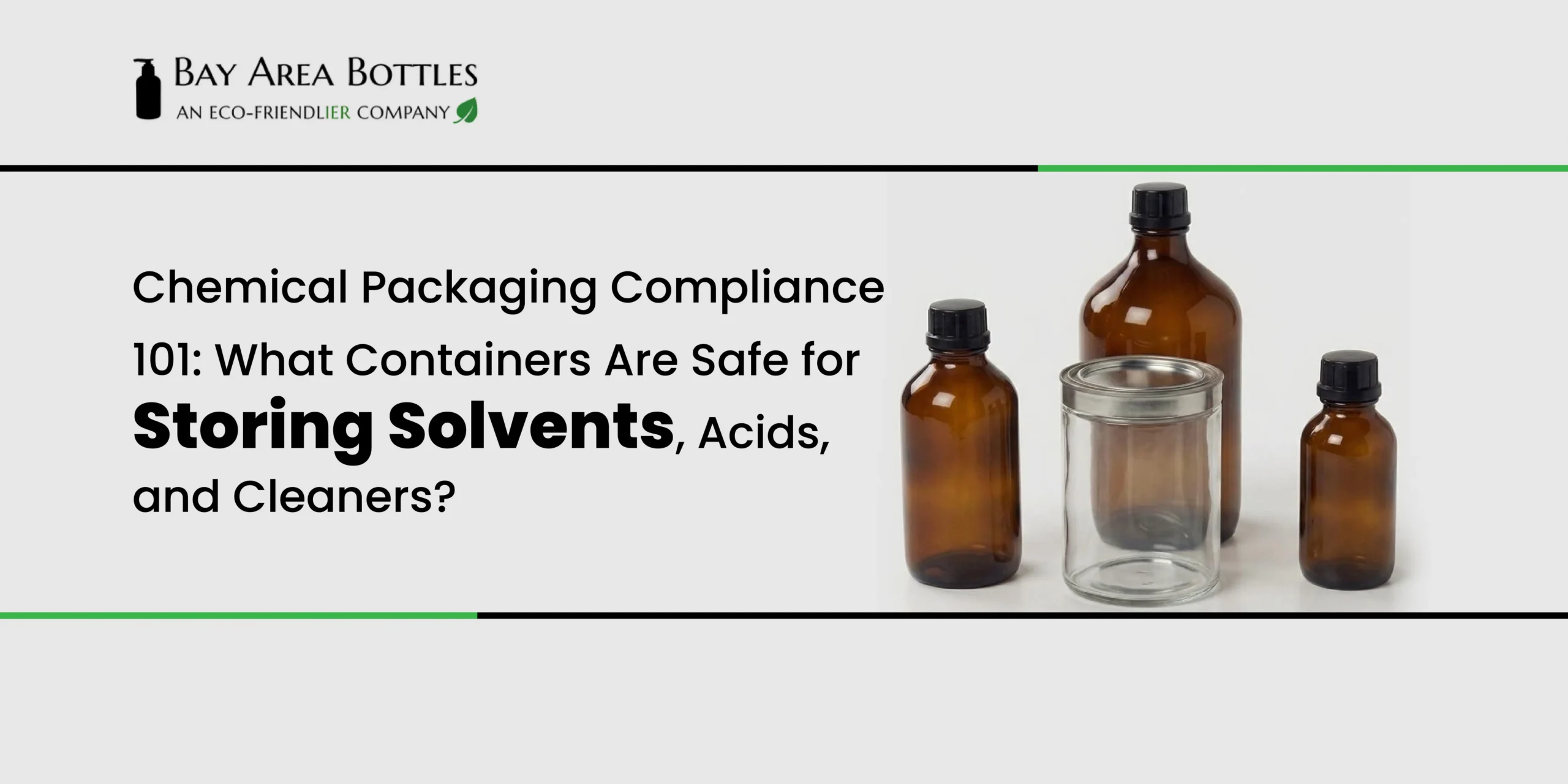
Borosilicate glass, in particular, is widely used for chemical storage due to its high resistance to corrosion and thermal shock. Meanwhile, amber glass bottles are used to store light-sensitive chemicals. The only downside is that glass is delicate and can easily break.
Some chemicals are highly reactive or corrosive. Standard plastic bottles won’t cut it. That’s where we use specialized materials like PTFE or fluorinated plastic bottles. A synthetic, hydrophobic, and non-reactive material. They’re often coated on pipes, gaskets, and seals for their chemically inert nature.
PTFE, normally known as Teflon, is one of the most chemically resistant materials available. They make perfect chemical storage containers for solvents. However, they release toxic fumes on overheating, causing polymer fume fever.
Chemical packaging compliance OSHA requires adherence to the Hazard Communication Standard (HCS 2012) (29 CFR 1910.1200), aligning with the Globally Harmonized System (GHS). Chemical containers must have GHS-compliant labels. It should include product identifier, signal word, pictograms, hazard statements, and precautionary statements. Employers must ensure all containers are properly labeled, maintain Safety Data Sheets (SDS), and train workers on hazards.
Let me save you from a few expensive mistakes I’ve seen way too often. Before you finalize your chemical packaging, make sure you’re not making these common mistakes:
Even a small mismatch can lead to container failure over time.
If you’re still unsure, I have made a simple stepwise guide you can easily follow:
Knowing the properties of your chemical is critical. Know if it’s acidic, alkaline, or solvent-based. Is it aggressive or reactive? Check its chemical composition and which materials it attacks.
Material safety data sheets are available in all places where reactive chemicals are in use. Always refer to material compatibility data before deciding. Even if you think you know, refer to the chart to double-check. Prevention is better than consequences.
Think about temperature, pressure, and exposure duration. Each chemical has different parameters. Even the duration and storage conditions can influence the reaction. Storing chemicals in an enclosed space can increase or decrease the temperature. Storing in deep underground can change the pressure. They are all critical contributors in any reaction.
Match your chemical with HDPE, PP, glass, or specialized materials. Not every material is compatible with every chemical. Once again, check the chart for compatibility before making your decision.
Make sure caps, liners, and seals are compatible too. It’s a small yet very important detail. Your bottle is useless if your cap is not shut tight. Even if the bottle material is impermeable, a loose cap will expose the chemical to all sorts of contaminants.
At the end of the day, chemical packaging is a responsibility. The right container keeps your product stable and protects users and handlers. It ensures compliance and builds trust in your brand.
And honestly, once you understand the basics, like material compatibility and proper sealing, it becomes much easier to make the right choice.
If you’re dealing with solvents, acids, or cleaners, don’t guess. Choose packaging that’s proven, tested, and aligned with industry standards. This beginner’s guide is a perfect starting point for safer chemical handling and storage.
Chemical safety isn’t optional. Compliance is your responsibility.